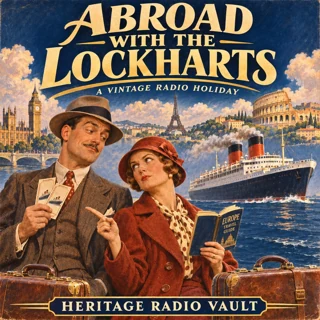
Abroad with the Lockharts
Comedy Fiction
Comedy Fiction
As a cornerstone of vintage radio comedy, Amos & Andy remains a significant part of Old Time Radio history. Collectors and enthusiasts will appreciate its cultural impact and the way it shaped the landscape of comedic programming. Fans of classic radio comedy, sitcoms, and character-driven humor will find much to enjoy in this series.

OFFICIAL HERITAGE RADIO VAULT RECORDING
Press Play in the official Spreaker player.
Open on Spreaker ↗The player connects to Spreaker, which may use cookies and serve advertising. Audio starts when you press Play. Spreaker privacy
A money-making scheme, a friendship and a misunderstanding could carry a radio story from one evening into the next. Amos and Andy became a major part of American broadcasting, but the programme also carries a contested history of racial representation.
The radio series began in 1928 and reached the NBC network in 1929. The Museum of Broadcast Communications distinguishes the original continuing serial from the weekly situation comedy introduced in 1943 and the later Music Hall format. Those versions should not be treated as one unchanging programme.
Freeman Gosden and Charles Correll created and performed the central radio characters. They were white performers portraying Black characters through dialect and racial characterisation. Later productions used a broader supporting company. Radio and television versions had different casts and production histories.
Kingfish Finds a Pistol · Kingfish Adopts Andy
These are available comic-story samples. Documentary material is also separately catalogued in HRV and should not be mistaken for another original fictional episode.
The Library of Congress preserves scripts submitted for copyright between 1928 and 1937. Their survival is separate from the survival of audio, so an archival script date does not prove that a matching sound recording is available.
Listen with attention to the changing format and historical context. The programme is significant to the development of serial broadcasting and the sitcom, while its racial portrayals require critical consideration rather than an unqualified celebration.
HRV lists 341 public records, including material from different periods and documentary entries. This count is not a verified total of distinct original broadcasts. Exact version and date identification require recording-level evidence. Current podcast dates describe later publication.
341 public recordings in this programme. Catalogue order is not a verified original broadcast chronology.
341 episodes available.
The original radio performers and later television company were different.
The programme combines broadcasting influence with racial portrayals that have been criticised and debated.
No. The HRV catalogue also contains separately titled documentary material.
Comedy Fiction

Comedy Fiction

Comedy Fiction