
21st Precinct
Drama
Drama
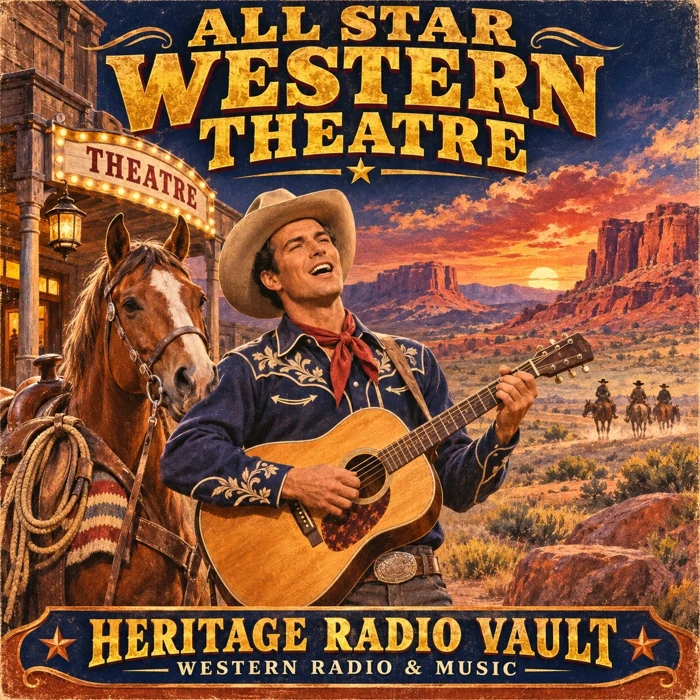
All Star Western Theatre is a classic Old Time Radio series that transports listeners to the rugged landscapes of the American West. This Western drama, originating from the golden age of radio, features thrilling tales of cowboys, outlaws, and frontier justice, capturing the essence of the Old West in each episode. Collectors and enthusiasts of vintage radio will appreciate the authentic soundscapes and engaging narratives that define All Star Western Theatre. This series remains a notable entry in the Western genre, appealing to fans of classic radio dramas and those who enjoy tales of adventure and heroism.
OFFICIAL HERITAGE RADIO VAULT RECORDING
Press Play in the official Spreaker player.
Open on Spreaker ↗The player connects to Spreaker, which may use cookies and serve advertising. Audio starts when you press Play. Spreaker privacy
A cowboy story and a song can share the same campfire. All Star Western Theatre combines guest performances, western drama and the music of Foy Willing and the Riders of the Purple Sage.
The programme belongs to American radio's 1946–1948 western entertainment. Radio Archives traces its early broadcasts to KNX and the CBS Pacific network, with a later move to KHJ and Mutual in 1948. Transcription recordings also enabled broadcasts in other markets, so local dates and later airings require care.
Cottonseed Clark hosted, while Foy Willing and the Riders of the Purple Sage provided the continuing musical identity. Guest actors and singers changed from programme to programme. A contemporary September 1946 Radio Life advertisement promotes the combination of the Riders, western drama and music.
Billy the Kid with Tex Ritter · Miss East Goes West with Jean Rogers · Streets of Laredo with Tex Ritter
These are available HRV titles representing different guest-led programmes. They are samples, not a ranking or a claim to be the earliest surviving broadcasts.
Airchecks and recordings prepared for syndication can represent different versions. Radio Archives describes transcription editions with musical breaks available for local advertising. A recording without a familiar network sponsor message should not automatically be considered a different story.
Choose it for a mixture of western voices and music rather than an uninterrupted detective-style plot. A familiar guest name or an opening musical selection can provide a useful way into the collection.
HRV lists ninety-two public recordings. That is a catalogue count, not a verified original-series total or proof of ninety-two unique stories. Syndication, differing titles and later airings can complicate date matching. Modern podcast dates are separate from historical transmission dates.
92 public recordings in this programme. Catalogue order is not a verified original broadcast chronology.
92 episodes available.
No. Music is a central part of the format alongside western dramatic stories and guest performances.
Foy Willing and the Riders of the Purple Sage provide the programme's recurring musical identity.
Transcription editions could leave space for local sponsor messages, while network airchecks preserved a different broadcast context.