

2000 Plus
Science Fiction
Science Fiction
Civilisation has destroyed itself. A few monks are trying to save what remains of its knowledge. What happens when the world learns to use it again? Discover A Canticle for Leibowitz on Heritage Radio Vault, the radio adaptation of Walter M. Miller Jr.’s landmark post-apocalyptic science fiction novel. Across a long imagined future, the survival of books, ideas and scientific learning becomes inseparable from the survival of humanity itself.
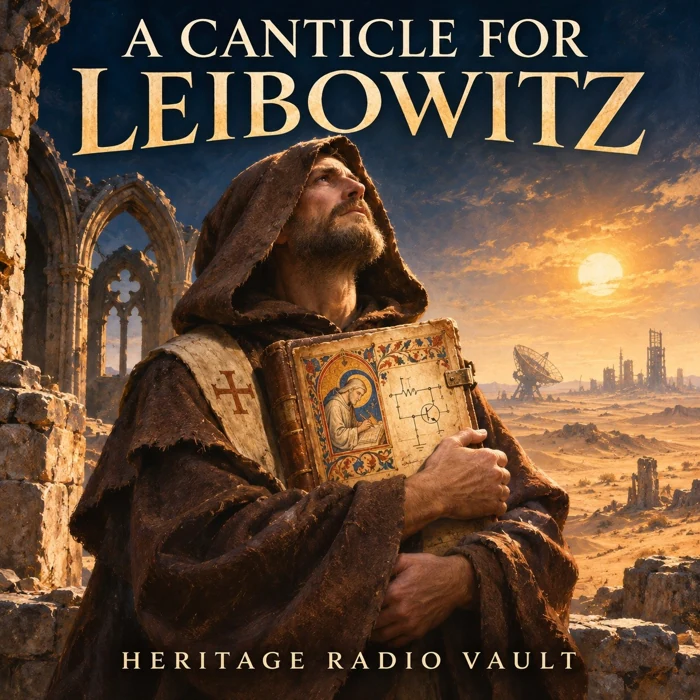
OFFICIAL HERITAGE RADIO VAULT RECORDING
Press Play in the official Spreaker player.
Open on Spreaker ↗The player connects to Spreaker, which may use cookies and serve advertising. Audio starts when you press Play. Spreaker privacy
After catastrophe, even understanding an old document can become an act of faith. This continuing drama follows the preservation of knowledge through a damaged world, asking what people remember, what they forget and what they choose to build again.
This fifteen-part radio serial adapts Walter M. Miller Jr.'s novel for WHA and public radio. Collector Frank M. Passage places the initial run in 1981–1982. The American Archive of Public Broadcasting also documents an October 1982 presentation and a November 1982 NPR Playhouse broadcast. Those later dates should not automatically be treated as the first airing.
The archival record credits Karl Schmidt as director and producer. Its closing-credit transcript identifies John Reeves as adaptor and Carol Cowan as narrator. These credits concern the American fifteen-part production; other radio versions of the novel have different teams.
Part 1: The Fallout Shelter · Part 2 · Part 3
These are the first three numbered entries available in HRV. Continue in part-number order; the podcast listing's publication order is not a substitute for the serial sequence.
The story carries its monastery and its concern with knowledge across different historical periods. It is a continuing serial rather than fifteen unrelated anthology stories.
Begin at the start and allow the setting to develop. This is a choice for listeners who want a sustained speculative drama about memory, belief and rebuilding, rather than a quick self-contained mystery.
HRV lists fifteen public recordings. Historical logs differ on some dates and spellings, so the production credits above follow the archival record and transcript. The broadcast history distinguishes the collector's initial-run dates from the archive's documented 1982 presentation. Modern podcast publication dates are separate.
15 public recordings in this programme. Catalogue order is not a verified original broadcast chronology.
15 episodes available.
Yes. Begin with Part 1 and continue by part number, because this is a continuing serial.
No. This guide concerns the American fifteen-part production. Other radio adaptations have different lengths and production teams.
No. The historical record includes more than one broadcast presentation, while podcast dates describe the later publication of these audio records.

